
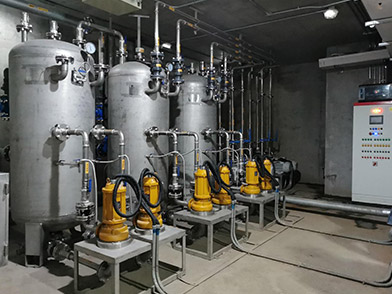
Vacuum Negative-Pressure Drainage Technology: Principles, Advantages, Environmental Applications and Prospects
The development history of negative-pressure drainage
In 1869 an invention by the Dutchman Liernur opened a new chapter in drainage technology, and negative-pressure drainage was born. The innovation was quickly applied in Amsterdam, Berlin, Paris and other European cities, showing its unique appeal. However, limited by the technical level of the time and the constraints of social development, by the 1910s negative-pressure drainage gradually lost its advantage and was replaced by gravity-flow pipes and sewage pumping stations, like a meteor briefly crossing the long history of drainage technology.
As time passed, in the 1970s and 1980s, with continuing technical progress, negative-pressure drainage found an opportunity for revival. But by then urbanisation in Europe and North America was largely complete, and sewage and drainage systems had settled into a fixed pattern of mixed discharge, gravity-flow pipe transport combined with booster pumping stations and large centralised treatment. Although this pattern met urban drainage needs for a period, it also limited room for innovation and blocked the shift of drainage systems towards refinement and resource recovery, so negative-pressure drainage made no major breakthroughs over the following decades.
Principles and composition of negative-pressure drainage systems
1. System principle
The negative-pressure drainage network is similar in many ways to the familiar pressurised water supply network, except that the medium flows in the opposite direction. The water supply network uses pressure to deliver water from the source to users, while the drainage network uses negative pressure to draw sewage from users to a collection centre. In a negative-pressure system, sewage in the collection unit overcomes gravity and other resistances under negative pressure, so that water flows uphill into the negative-pressure network and finally collects at the central station.
2. System composition
Sewage collection unit: this unit mainly consists of negative-pressure collectors, negative-pressure toilets and similar devices. They act as the tentacles of the system, collecting sewage generated by users and connecting it to the negative-pressure network. Negative-pressure toilets and related devices are designed with efficient sewage collection and convenient network connection in mind, ensuring smooth entry of sewage into the network.
3. Negative-pressure network unit: the network unit is like the blood vessels of the human body, connecting dispersed sewage collection units in a network. It carries the important task of gathering sewage from every collection point to the collection centre, and its carefully designed layout ensures sewage flows quickly and steadily under negative pressure.
Negative-pressure central station: the central station is the heart of the whole system. It has two main functions: generating and maintaining the negative pressure required by the system to power sewage transport, and temporarily storing sewage pending treatment or transfer. The station is equipped with advanced Vacuum Pumps and other equipment to ensure stable system operation.
4. Monitoring system: the monitoring system is the intelligent brain of negative-pressure drainage, enabling automatic operation. Where required it provides remote alarms, remote diagnostics and control. Sensors and other devices monitor system status in real time, and faults or abnormalities trigger timely alarms with remote control adjustments and repairs, greatly improving reliability and Maintenance efficiency.
Advantages of negative-pressure drainage systems
1. Not constrained by building structure, environment or terrain
Compared with conventional gravity drainage, negative-pressure drainage offers great flexibility. Gravity systems require careful consideration of building structure, environment and terrain during design and construction, because sewage must flow by gravity, so pipe laying is heavily constrained. Negative-pressure systems are different: unbound by these conditions, they can be installed flexibly in complex buildings, areas with significant terrain variation and harsh environments. In renovating old buildings, for example, where complex structures make re-laying gravity pipes difficult, negative-pressure drainage solves the problem easily.
2. Self-cleaning action prevents sediment and silt build-up
The medium carried in a negative-pressure network is a mixture of sewage and gas moving much faster than in gravity pipes. This high-speed flow gives the pipes a self-cleaning action that effectively prevents sediment and silt accumulation. In conventional gravity pipes, slow flow lets solids and impurities settle at the bottom, eventually causing blockages that need frequent cleaning and maintenance. The self-cleaning function of negative-pressure drainage keeps pipes clear over the long term, reducing maintenance cost and workload. It also makes long-distance transport of small-flow, high-concentration, easily depositing media possible, providing an effective solution for sewage discharge in special areas.
3. Simpler pipe laying and construction
Negative-pressure transport pipes have a much smaller diameter than gravity pipes and, unlike gravity systems, do not need progressively deeper burial to create the slope required for gravity flow. Smaller diameters reduce material cost and the area of ground excavation during construction. No need for extra burial depth simplifies the construction process and lowers difficulty and cost. In narrow city streets or areas with limited underground space, this advantage is even more obvious, allowing pipe laying and construction to proceed without disrupting the surrounding environment and traffic.
Leno vacuum pumps in the environmental protection industry
1. Key role of Leno vacuum pumps in negative-pressure drainage systems
In the central station of a negative-pressure drainage system, the vacuum pump is one of the core devices, and Leno vacuum pumps, with outstanding performance, play a vital role in environmental negative-pressure drainage. They efficiently generate and maintain the required negative pressure, ensuring sewage is drawn smoothly from every collection unit to the central station. Their stable operation guarantees system reliability and reduces the risk of shutdown caused by vacuum pump failure.
2. Technical features of Leno vacuum pumps
High vacuum: Leno vacuum pumps generate very high Vacuum Levels, meeting the strict negative pressure requirements of drainage systems. High vacuum makes sewage flow more smoothly in the network, improving transport efficiency and drawing sewage quickly from distant collection points to the central station.
High efficiency and energy saving: while delivering high vacuum, Leno pumps are also highly efficient. Advanced technology and optimised design maintain high vacuum at low energy consumption, reducing overall system operating costs and meeting the energy-saving and emission-reduction requirements of the environmental industry.
Strong reliability: Leno vacuum pumps have undergone strict quality testing and long-term practical verification, delivering high reliability. Robust structural design and quality materials let them run stably in harsh working environments, reducing maintenance frequency and repair costs and providing strong assurance for long-term stable system operation.
Low-noise operation: in noise-sensitive areas such as residential districts and schools, the quiet running of Leno vacuum pumps is particularly important. Advanced Noise Reduction technology keeps operating noise extremely low, causing no noise pollution to the surroundings and preserving quiet living and learning environments.
3. Application cases of Leno vacuum pumps in the environmental industry
Municipal wasteWater Treatment plant: the plant uses a negative-pressure drainage system to collect sewage from surrounding areas. Leno vacuum pumps run stably in the central station, providing reliable negative pressure for the whole system. Through the system, sewage is transported efficiently from each collection point to the plant, greatly improving collection efficiency and quality. The high efficiency of Leno pumps also lowers plant operating costs, achieving both economic and environmental benefits.
Industrial park: wastewater from enterprises in the park has the characteristics of small flow, high concentration and complex composition, and conventional drainage systems struggle to meet discharge needs. After introducing negative-pressure drainage, Leno vacuum pumps played an important role, smoothly collecting wastewater from each enterprise and transporting it to centralised treatment facilities. This effectively solved the park's wastewater discharge problem and safeguarded normal production and environmental quality.
Comparison of negative-pressure and conventional drainage
1. Drainage efficiency
Conventional systems rely mainly on gravity flow, with relatively slow sewage velocity; efficiency is low especially on flat terrain or with small flows. Negative-pressure systems draw sewage by vacuum, so flow velocity in the network is far higher than in conventional systems, allowing fast collection and transport to the treatment site and greatly improving efficiency. In extreme weather such as heavy rain, negative-pressure drainage removes standing water faster, reducing urban flooding risk.
2. Construction cost
Gravity pipes in conventional systems need larger diameters and, to create slope, often require deep trenching and greater burial depth, raising construction cost. In complex terrain or for long-distance transport, multiple sewage pumping stations may be needed, further increasing cost. Negative-pressure pipes are small in diameter, need no deep trenches for slope, and construction is relatively simple and cheaper. Although the system requires a central station and other equipment, overall construction cost is often still advantageous.
3. Maintenance cost
Because of slow flow, conventional systems easily develop sediment and silt in pipes, requiring frequent cleaning and maintenance at higher cost, and once a blockage occurs, finding and fixing it is difficult. Negative-pressure systems have a self-cleaning action, so sediment build-up is limited and maintenance workload is greatly reduced. Their monitoring system tracks operation in real time, identifying and solving problems promptly, lowering maintenance cost and failure risk.
4. Prospects for negative-pressure drainage
Urbanisation in emerging developing countries is proceeding vigorously, providing broad space for new drainage technologies. China has accumulated rich experience over more than two decades of rapid urbanisation, and as ecological civilisation and rural revitalisation advance, requirements for environmental protection and resource use keep rising. With its unique advantages, negative-pressure drainage technology now faces opportunities for comprehensive improvement and wide application.
In future, negative-pressure drainage is expected to make greater progress in the following areas:
1. Intelligent development: with the growth of IoT and big data, negative-pressure drainage systems will become more intelligent. Monitoring systems will collect more data in real time and use analysis for precise control and optimisation, further improving efficiency and reliability.
2. Integration with other environmental technologies: negative-pressure drainage can integrate better with wastewater treatment and resource recovery. For example, preliminary treatment at the central station can recover part of the water resource, reducing pollution and improving resource efficiency.
3. Expansion of application fields: the technology can serve not only urban and rural drainage but also special fields such as mines and offshore platforms, where high demands on drainage systems allow its advantages to be fully exploited.
In short, negative-pressure drainage technology has enormous potential in the environmental industry. As technology advances and applications spread, it will make greater contributions to urban construction and environmental protection.
