Introduction
With the rapid expansion of AI large models, high-performance simulation and computing scheduling businesses, many existing computing rooms already built and commissioned in China are hitting Cooling bottlenecks: conventional air cooling supports only cabinet loads within 8 kW and cannot carry high-density GPU cluster deployment, while conventional positive-pressure liquid cooling carries leakage and short-circuit risks with high retrofit cost and poor adaptability. A recently standardised cold plate liquid cooling plus Negative Pressure CDU solution for upgrading existing rooms has become the mainstream implementation route, stably carrying 30 kW high computing loads per cabinet with annual average PUE as low as 1.18. Relying on domestic hardware to compress retrofit cost and standardised redundant negative pressure Vacuum Pumps, it solves the three pain points of computing expansion, energy saving and operational safety in old rooms in one package, providing a replicable, cost-effective standardised path for high-density retrofits of the huge stock of computing infrastructure nationwide.
1. Industry pain points: existing computing rooms face a dilemma, and high-density cooling urgently needs a technology breakthrough
Most general computing rooms in China commissioned between 2015 and 2022 rely mainly on air cooling, with designed cabinet power typically 5 to 10 kW. As AI Training, scientific computing and rendering workloads move in, the density of GPUs and CPUs installed per cabinet rises sharply and cabinet heat loads surge, so air cooling systems show insufficient cooling, equipment overheating and frequency reduction, and frequent local hot spots, greatly undermining computing stability.
Rebuilding the room entirely means renewing civil works, power distribution and HVAC, with retrofit periods often exceeding six months, long downtime for computing services and investment running into tens of millions of yuan. Conventional positive-pressure cold plate liquid cooling drives coolant circulation with pumps, and pipe pressure is above atmospheric, so if ageing pipes or loose joints fail, coolant sprays outward and easily short-circuits server boards and crashes machines, creating serious Maintenance safety hazards. Immersion liquid cooling has a higher cooling ceiling, but requires full cabinet retrofit and structural reinforcement of the room, and dedicated fluorinated coolant procurement costs are very high, making it poorly suited to existing rooms; most enterprises cannot implement it due to budget, space and business continuity constraints.
At the same time, the national East-to-West Computing Resource Transfer project and local new data centre policies explicitly require computing room PUE to be controlled within 1.25, and first-tier cities such as Beijing, Shanghai, Guangzhou and Shenzhen have tightened energy efficiency red lines further. The existing air-cooled rooms commonly run at PUE 1.6 to 1.8, unable to meet energy-saving compliance requirements. High-density expansion, green low-carbon operation, safety and stability, and low-cost retrofit are intertwined demands, and the market urgently needs a lightweight liquid cooling solution suited to older rooms. Against this background, cold plate liquid cooling with a negative pressure CDU architecture has risen to become the mainstream technical route for high-density upgrades of existing rooms thanks to its safety, adaptability and energy performance.
2. Mainstream architecture: cold plate liquid cooling plus negative pressure CDU, with standardised 30 kW cabinet configuration
This standardised existing-room upgrade solution uses a cold plate liquid cooling plus negative pressure CDU package, making minimal-intrusion retrofits to existing rooms without changing floor load capacity or the overall HVAC cable trays, adapting to the piping layout of the vast majority of conventional rooms. The standardised single cabinet is designed for a stable 30 kW load with annual comprehensive PUE held at 1.18, perfectly balancing high-density cooling and green energy saving.
Each cabinet comes standard with one integrated CDU that combines three core components, cooling cold plates, a plate heat exchanger and a circulation drive pump, forming a complete heat exchange loop. The working logic is clear and efficient: cold plates attach to the surfaces of high-heat chips such as server CPUs and GPUs, and low-temperature coolant carries heat directly away from the chips; the heated coolant flows into the CDU heat exchanger and exchanges heat with the room's external cooling source; the cooled coolant is driven by the power unit back to the cabinet cold plates, achieving closed-loop uninterrupted cooling. Cold plates cool only the core heat-generating components precisely, while the remaining server hardware keeps its original air cooling, so existing servers need no full replacement and only cold plate accessories are added, greatly reducing hardware retrofit cost and downtime and adapting to mainstream server brands.
Unlike conventional positive-pressure CDUs, this system circulates coolant under negative pressure, a leap forward in safety. Conventional liquid cooling piping runs under positive pressure and leaks when damaged; the negative pressure CDU keeps the entire secondary loop under negative pressure below atmospheric, so if pipes crack or joints seep, outside air flows inward and coolant does not spray out, eliminating the root cause of leakage burning machines and suiting businesses with zero-fault requirements such as finance, computing scheduling and government services. The system maintains a stable negative pressure of -0.085 to -0.095 MPa, which also reduces air dissolved in the coolant, inhibits corrosion and microbial growth on pipe walls and extends the life of piping and cold plates, lowering long-term maintenance frequency.
On cost, the complete domestic hardware retrofit budget is locked at 120,000 to 180,000 yuan per cabinet, covering the CDU unit, cold plates, piping, Installation and commissioning and pipe leak testing. Compared with imported liquid cooling equipment at over 250,000 yuan per cabinet, the domestic solution cuts cost by more than 30 percent, while domestic components have short delivery cycles and fast maintenance response, suiting batch room retrofits across all regions with controllable upfront cost and easy long-term maintenance.
3. Core power of the negative pressure CDU: standardised Leno two-stage Rotary Vane Vacuum Pumps with duty and standby for all-weather reliability
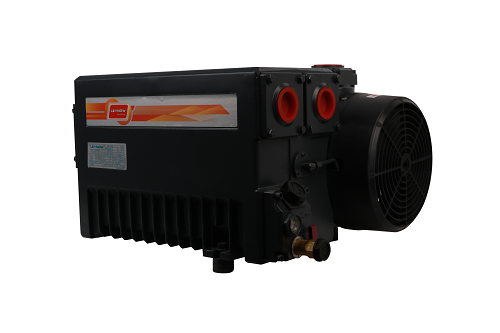
The Vacuum pump is the core hardware that lets the negative pressure CDU maintain pipe negative pressure and drive coolant circulation. This solution uniformly uses Leno two-stage rotary vane vacuum pumps, preferring dry oil-free models to avoid oil mixing into the coolant and contaminating piping or clogging cold plates, meeting the long-term cleanliness requirements of liquid cooling.
(1) Standardised key vacuum pump parameters
Pumping capacity: rated pumping speed 20 to 30 m3/h, enabling fast evacuation of the whole piping run and quick entry into the stable negative pressure range;
Working vacuum: stable operating range -0.085 to -0.095 MPa, with ample tolerance for minor air ingress and flow fluctuation so negative pressure does not oscillate violently;
Power configuration: motor power 1.5 to 2.2 kW, compatible with standard industrial 380 V three-phase mains, requiring no large-scale modification of existing room power distribution or additional distribution cabinets;
Recommended models: LD 0020, LD 0030 and LD 0040, mature domestic models verified in many data centre liquid cooling projects, with stability and durability suited to 7x24 uninterrupted operation.
(2) Redundant configuration: one duty plus one standby, eliminating single points of failure
To guarantee uninterrupted computing operation all year, the solution mandates two vacuum pumps, one duty and one standby, per negative pressure CDU as a complete redundant backup. Under normal conditions the duty vacuum pump handles all evacuation, circulation drive and pipe pressure stabilisation; pressure sensors monitor pipe negative pressure in real time, and if the duty pump fails or negative pressure drops below the threshold, the control system switches to the standby pump within milliseconds, without stopping or losing cooling, avoiding cabinet overheating and computing frequency reduction caused by vacuum pump shutdown.
A Leno domestic vacuum pump costs only 4,500 to 7,000 yuan per unit, keeping the hardware cost of the dual-pump configuration controllable and gaining high system availability at a very low incremental hardware cost. Besides daily circulation and pressure stabilisation, the vacuum pump serves two essential maintenance functions: first, vacuum leak testing at completion of the whole liquid cooling piping run, combined with nitrogen pressure holding tests to pinpoint tiny leaks and ensure construction quality; second, repeated evacuation and nitrogen pressure holding during annual overhauls to provide routine pipe health checks, eliminating leakage risks before they occur. The Vacuum System thus carries both operational drive and safety leak testing value, forming the cornerstone of the negative pressure liquid cooling safety system.
4. Core value: suited to existing room retrofits, solving long-term industry pain points on multiple fronts
1. Lightweight retrofit, suited to older rooms, with minimal business impact
Cold plate retrofits are incremental: existing room air conditioning and cable trays are not removed, floors need no reinforcement, and piping follows existing routes. Servers only swap cooling modules, and retrofits can be done cabinet by cabinet with staggered construction, allowing computing services to migrate in batches without full network shutdown. Compared with immersion liquid cooling, which requires customised cabinets, structural reinforcement and waterproofing, this solution maximises compatibility with existing buildings and can be deployed in old parks, high-rise rooms and load-restricted rooms.
2. Excellent energy performance, with PUE 1.18 achieving policy compliance
Conventional air-cooled rooms typically run at PUE above 1.6, while this solution brings annual average PUE down to 1.18, sharply reducing cooling system energy consumption. On one hand, cold plates carry chip heat precisely, greatly reducing room air conditioning load; on the other, the negative pressure CDU power consumption is optimised, with vacuum pumps and circulation pumps using far less power than conventional high-power water cooling units. For a medium computing room of one hundred cabinets, annual cooling electricity savings can reach several hundred thousand kWh, meeting local PUE control policies while achieving long-term reductions in computing operating costs, in line with dual-carbon goals.
3. Negative pressure safety net, with leakage risk virtually eliminated
Negative pressure physics completely reverse the positive-pressure liquid cooling weakness that leakage means risk; combined with periodic nitrogen leak testing by the vacuum pump, piping is inspectable and controllable throughout its life. For finance, cloud and government enterprise computing that cannot stop, safety redundancy is greatly enhanced and equipment failure rates and hardware repair costs fall significantly.
4. Fully domestic chain, with controllable cost and independent supply
The CDU, cold plates and vacuum pumps all use mature domestic hardware, with a per-cabinet price range of 120,000 to 180,000 yuan suited to most retrofit budgets. The domestic supply chain delivers reliably, with local parts replacement and on-site maintenance, free of long import lead times, cumbersome after-sales and spare part price rises, making it suitable for operators, cloud providers and government enterprises building computing centres at scale.
5. Deployment prospects: becoming the mainstream route for existing computing upgrades and supporting high-density computing adoption
More than 70 percent of China's computing infrastructure consists of existing rooms, and the market for high-density cooling retrofits will be vast over the next three years. This standardised 30 kW per cabinet cold plate negative pressure liquid cooling solution closes the full chain of no major demolition in old rooms, doubled computing density, energy compliance, no leakage and domestic cost control. It has mature deployment cases verifying stability and achieves standardised hardware and unified parameters, making batch design and construction easy for design institutes and integrators and unified standardised inspection easy for maintenance teams.
Deployment can be flexibly split by room scale: small computing rooms retrofit cabinet by cabinet as needed; large parks implement module by module, with every cabinet using the same CDU and vacuum pump configuration, interchangeable spare parts and greatly reduced maintenance difficulty. For future higher-density computing needs, the architecture can be upgraded to 40 kW cabinets by only adjusting cold plate heat exchange area and vacuum pump pumping speed, with no need to rebuild piping or the negative pressure logic, offering excellent long-term expansion flexibility.
Industry experts note that under the triple trends of surging AI computing demand, a huge stock of existing rooms and tightening energy-saving policy, the cold plate liquid cooling plus negative pressure CDU solution has moved from pilot technology to a mainstream industry solution thanks to its high adaptability and overall cost-effectiveness. The maturity of domestic hardware further lowers the threshold for high-density computing deployment, allowing small and medium computing enterprises to upgrade rooms without heavy investment, and helping China's computing infrastructure iterate towards higher density, lower carbon and greater safety.
Conclusion
The essence of upgrading the computing foundation is balancing computing ceiling, retrofit cost, operational safety and energy indicators. The standardised 30 kW per cabinet cold plate negative pressure liquid cooling solution precisely targets existing room retrofit pain points: negative pressure CDUs solve safety challenges, domestic hardware controls investment, the cold plate architecture guarantees cooling density, and ultra-low PUE of 1.18 meets green compliance requirements. As more existing intelligent and general computing rooms complete batch deployment, this standardised liquid cooling solution will continue to empower the high-quality construction of China's computing network, providing a stable, low-carbon and cost-effective high-density computing hardware foundation for AI, industrial simulation, cloud computing and other digital industries.